Enlarged
Prostate Signs & Symptoms
By the National
Institute of Health
Symptoms
of acute prostatitis (enlarged prostate) include the following:
- Fever
- Chills
- Low back
pain - Abdominal
pain (above the pubic bone) - Perineal
pain (pelvic floor) - Pain
and burning with urination (dysuria) - Urinary
retention (inability to completely empty bladder) - Pain
with ejaculation - Pain
with bowel movement
Additional
symptoms that may be associated with this condition:
- Blood
in the urine - Increased
urinary frequency or urgency - Difficulty
urinating - Decreased
force of urinary stream - Testicle
pain - Blood
in the semen - Foul-smelling
urine
Acute prostatitis often begins with chills and fever, lower abdominal discomfort, perineal pain (pain in the area between the genitals and the anus), and burning with urination. Symptoms of more advanced prostatitis include a diminished urine stream and difficulty urinating.
Prostatitis may occur in conjunction with epididymitis or orchitis, especially if caused by an STD, in which case symptoms of the accompanying condition may also be present.
Prostate Changes
That Are Not Cancer – Enlarged prostate Symptoms
What
is prostatitis and how is it treated?
What is enlarged prostate or BPH?
How can BPH be treated?
What
is prostatitis and how is it treated?
Prostatitis
(pronounced “PRAH-stuh-TYE-tis”) is an inflammation or infection
of the prostate gland. It affects at least half of all men at some time
in their lives. Having this condition does not increase your risk of any
other prostate disease.
Enlarged
|
|
Prostatitis
is not contagious. It is not spread through sexual contact. Your partner
cannot catch this infection from you.
Several
tests, such as DRE and a urine test, can be done to see if you have prostatitis.
Getting the right diagnosis of your exact type of prostatitis is the key
to getting the best treatment. Even if you have no symptoms, you should
follow your doctor’s suggestion to complete treatment.
There are four types
of prostatitis:
Acute
bacterial prostatitis
This infection
comes on suddenly (acute) and is caused by
bacteria. Symptoms include severe chills and fever. There is often blood
in the urine. You must go to the doctor’s office or emergency room for
treatment. It’s the least common of the four types, yet it’s the easiest
to diagnose and treat.
| Treatment: | Most cases can be cured with a high dose of antibiotics, taken for 7 to 14 days, and then lower doses for several weeks. You may also need drugs to help with pain or discomfort. |
Chronic bacterial
prostatitis
Also caused
by bacteria, this condition doesn’t come on suddenly, but it can be bothersome.
The only symptom you may have is bladder infections that keep coming back.
The cause may be a defect in the prostate that lets bacteria collect in
the urinary tract.
| Treatment: | Antibiotic treatment over a longer period of time is best for this type. Treatment lasts from 4 to 12 weeks. This type of treatment clears up about 60 percent of cases. Long-term, low-dose antibiotics may help relieve symptoms in cases that won’t clear up. |
Chronic prostatitis
or chronic pelvic pain syndrome
This disorder
is the most common but least understood form of the disease. Found in
men of any age from late teens to elderly, its symptoms go away and then
return without warning. There can be pain or discomfort in the groin or
bladder area.
| Treatment: | There are several different treatments for this problem, based on your symptoms. These include antibiotics and other medicines, such as alpha-blockers. Alpha-blockers relax muscle tissue in the prostate to make passing urine easier. |
Asymptomatic inflammatory
prostatitis
You usually
don’t have symptoms with this condition. It is often found when your doctor
is looking for other conditions like infertility
or prostate cancer. If you have this problem, often your PSA test (see
The
PSA Test) will show a higher number than normal. It does not necessarily
mean that you have cancer.
| Treatment: | Men with this condition are usually given antibiotics for 4 to 6 weeks, and then have another PSA test. |
“Changes
happen so slowly that you don’t even realize they’re happening.”
What
is enlarged prostate or BPH?
BPH stands
for benign prostatic hyperplasia (pronounced “be-NINE prah-STAT-ik
HY-per-PLAY-zha”).
Benign means
“not cancer,” and hyperplasia means too much growth. The result is that
the prostate becomes enlarged. BPH is not linked to cancer and does not
raise your chances of getting prostate cancer–yet the symptoms for BPH
and prostate cancer can be similar.
| BPH Symptoms |
BPH symptoms
|
BPH affects
most men as they get older. It can lead to urinary problems like those
with prostatitis. By age 60, many men have signs of BPH. By age 70, almost
all men have some prostate enlargement.
The prostate
starts out about the size of a walnut. By the time a man is 40, it may
have grown slightly larger, to the size of an apricot. By age 60, it may
be the size of a lemon.
As a normal
part of aging, the prostate enlarges and can press against the bladder
and the urethra. This can slow down or block urine flow. Some men might
find it hard to start a urine stream, even though they feel the need to
go. Once the urine stream has started, it may be hard to stop. Other men
may feel like they need to pass urine all the time or are awakened during
sleep with the sudden need to pass urine.
Early BPH
symptoms take many years to turn into bothersome problems. These early
symptoms are a cue to see your doctor.
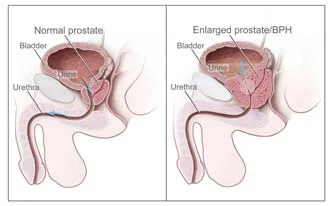
Urine flow of normal (left) and enlarged prostate (right). In diagram
on the left, urine flows freely. On the right, urine flow is affected
because of the prostate pressing on the bladder and urethra.
How
can BPH be treated?
About half
the men with BPH eventually have symptoms that are bothersome enough to
need treatment. BPH cannot be cured, but drugs or surgery can often relieve
its symptoms. BPH symptoms do not always grow worse.
There are
three ways to manage BPH:
- Watchful
waiting (regular follow-up with your doctor) - Drug
therapy - Surgery
Talk with
your doctor about the best choice for you. Your symptoms may change over
time, so be sure to tell your doctor about any new changes.
Watchful waiting
Men with
mild symptoms of BPH who do not find them bothersome often choose this
approach.
Watchful
waiting means getting annual checkups. The checkups can include DREs and
other tests (see “Types
of Tests“). Treatment is started only if symptoms become too much
of a problem.
If you choose
to live with symptoms, these simple steps can help:
- Limit
drinking in the evening, especially drinks with alcohol or caffeine. - Empty
the bladder all the way when you pass urine. - Use the
restroom often. Don’t wait for long periods without passing urine.
“My
doctor and I decide visit by visit about how long I should stay on watchful
waiting for my BPH.
Some medications
can make BPH symptoms worse, so talk with your doctor or pharmacist about
any medicines you are taking such as:
- Over-the-counter
cold and cough medicines (especially antihistamines) - Tranquilizers
- Antidepressants
- Blood
pressure medicine
Drug therapy
Millions
of American men with mild-to-moderate BPH symptoms have chosen prescription
drugs over surgery since the early 1990s.
There are
two main types of drugs used. One type relaxes muscles near the prostate
while the other type shrinks the prostate gland. There is evidence that
shows that taking both drugs together may work best to keep BPH symptoms
from getting worse.
Alpha-blockers
These drugs
help relax muscles near the prostate to relieve pressure and let urine
flow more freely, but they don’t shrink the size of the prostate. For
many men, the drug can improve urine flow and reduce symptoms within days.
Possible side effects include dizziness, headache, and fatigue.
5 alpha-reductase
inhibitor
This drug,
known as finasteride, shrinks the prostate.
It relieves symptoms by blocking an enzyme
that acts on the male hormone, testosterone, to boost organ growth. When
the enzyme is blocked, growth slows down.
This helps shrink the prostate, reduce blockage, and limit the need for
surgery.
Taking this
drug for at least 6 months to 1 year can increase urine flow and reduce
your symptoms. It seems to work best for men with very large prostates.
You must continue to take the drug to prevent symptoms from coming back.
This drug
is also used to treat baldness in men. It can cause these side effects
in a small percentage of men:
- Decreased
interest in sex - Trouble
getting or keeping an erection - Smaller
amount of semen with ejaculation
It’s important
to note that taking this drug can lower your PSA test levels. There is
also evidence that finasteride lowers the risk of getting prostate cancer,
but whether it lowers the risk of dying from prostate cancer is still
unclear.
| BPH Medications |
|||
| Category | Activity | Generic Name |
Brand Name |
| Alpha-blockers | Relax muscles near prostate |
doxazosin tamsulosin terazosin prazosin |
Cardura Flomax Hytrin Minipres |
| 5 alphareductase inhibitor |
Slows prostate growth, shrinks prostate |
finasteride | Proscar or Propecia |
BPH surgery
The number
of prostate surgeries has gone down over the years. But operations for
BPH are still one of the most common surgeries for American men. Surgery
is used when symptoms are severe or drug therapy has not worked well.
Types of
surgeries include:
-
TURP
(transurethral resection of the prostate) is the most common surgery
for BPH. It accounts for 90 percent of all BPH surgeries. It takes
about 90 minutes. The doctor passes an instrument through the urethra
and trims away extra prostate tissue. A spinal block is used to numb
the area. Tissue is sent to the laboratory to check for prostate cancer.TURP
generally avoids the two main dangers linked to other prostate surgeries:- Incontinence
(not being able to hold in urine) - Impotence
(not being able to have an erection)
The recovery
period for TURP is much shorter as well. - Incontinence
-
TUIP
(transurethral incision of the prostate) is similar to TURP. It
is used on slightly enlarged prostate glands. The surgeon places one
or two small cuts in the prostate. This relieves pressure without
trimming away tissue. It has a low risk of side effects. Like TURP,
this treatment helps with urine flow by widening the urethra. -
TUNA
(transurethral needle ablation) burns away excess prostate tissue
using radio waves. It helps with urine flow, relieves symptoms, and
may have fewer side effects than TURP. Most men need a catheter
to drain urine for a period of time after the procedure. -
TUMT
(transurethral microwave thermotherapy) uses microwaves sent through
a catheter to destroy excess prostate tissue. This can be an option
for men who should not have major surgery because they have other
medical problems. -
TUVP
(transurethral electroevaporation of the prostate) uses electrical
current to vaporize prostate tissue. -
Open
prostatectomy means the surgeon removes the prostate through a
cut in the lower abdomen. This is done only in very rare cases when
obstruction is severe, the prostate is very large, or other procedures
can’t be done. General or spinal anesthesia is used and a catheter
remains for 3 to 7 days after the surgery. This surgery carries a
higher risk of complications than medical treatment. Tissue is sent
to the laboratory to check for prostate cancer.
Be sure to
discuss options with your doctor and ask about the potential short- and
long-term benefits and risks with each procedure. For a list of questions
to ask, see Checklist
of Questions for Your Doctor.