   Food  Water  Medicine  Music  Naturopathic Doctors |
 Water Filters – Made In The USA Page Updated: 7-28-2010 Free Information Therapy |
Water FiltersWater Filter Systems Review Guide A Guide to Drinking Water Contaminates Common Drinking Water Contaminates Drinking Fluoride – Toxic Side Effects Hazardous Chlorination By-Products in Drinking Water Why Filter Chlorine From Your Shower? Drinking Water and Women’s Health Whole House Water Softeners and Conditioners Mineral Water ResearchWater Filter DirectoriesDrinking Water Association Directory |
Sprite High Capacity Shower Filter
No carbon media is used. Hot shower water exhausts carbon filter media after several uses. Carbon vs. KDF?
Say “Goodbye” To Chlorine With These Shower Filters
|
 Sprite’s High Capacity shower filter removes chlorine and chloramines from your shower, providing a natural way to manage skin and hair care. KDF-55™ filter media removes 98.9% chlorine, hydrogen sulfide, iron oxides (rust water), odors, and heavy metals. KDF inhibits the growth of bacteria, fungus, and mold.


|
Sprite High Capacity Shower Filter$49Sprite High Capacity Shower Filter Allow 10 days delivery |
 United States Mainland |
Sprite shower filters have 1/2 inch threaded fittings, compatible with your favorite shower head. All shower pipes in the United States are a standard 1/2 inch in size.
|
Sprite High Capacity $29 Allow 10 days delivery |
Sprite High Capacity Replacement FilterTop selling brand combines carbon and KDF Rainshower CQ1000 Sprite High Capacity Replacement filter for models HO and RSF |
KDF-55™ or Carbon Shower Filters?
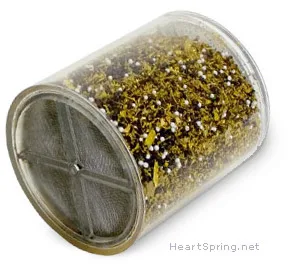
Different from carbon’s limited adsorption capability, KDF  creates an electrochemical environment. This galvanic action allows for the reversal of the original chlorine creation process.
This electrochemical reversal converts Free Available Chlorine to a harmless and soluble calcium
chloride. For those not familiar , KDF™ media is a brass alloy (copper and zinc). These dissimilar
metals allow for the creation of the galvanic action. This principle allows for long term usage
impeded only by sediment or particulate matter that might occlude the surface, thereby reducing
the media’s ability to generate electricity.
Activated carbon filters contain particles of carbon that have been treated to increase their surface area and increase their ability to adsorb a wide range of contaminants. Coconut shell carbon and bituminous (coal) carbon are the most common sources of carbon in activated carbon filters. The raw carbon source is slowly heated in the absence of air to produce a high carbon material. Passing oxidizing gases through the material at extremely high temperatures activates the carbon. As the water passes over the positively charged carbon surface, the negative ions of the contaminants are drawn to the surface of the carbon granules. This is known as ADSORPTION [to adhere] and can be closely compared in principle to magnetism.
As a general rule the adsorption ability of Activated Carbon depends largely on a number of factors. They are as follows:
TURBIDITY: How clean is the water from fine particulate matter. The cleaner the incoming water, the greater is the ability to adsorb.
FLOW RATE: Gushing water is not filtered as well as water flowing at slower speeds. Example, if you were to throw a nail past the head of a magnet the odds of it adhering would be slight. Carbon is primarily used in drinking water filters which have a lower flow rate of ½ to 1 GPM (Gallons per minute) Water entering a shower filter is usually at a higher flow rate of approximately 2.5 GPM.( 5 time faster than through a water filter), far too fast for proper adsorption. Even using cold water, a minimum of 5 times the amount of carbon would be necessary to filter the shower water.
CONTACT TIME: Water must be in contact with the activated carbon for a sufficient period of time to allow the activated carbon to effectively adsorb the contaminants. With a cartridge size of approximately 2.5 to 3 inches, shower filters containing carbon do not contain sufficient media to adsorb at the above mentioned 2.5 GPM flow rate. Most drinking filters produce .5-1 GPM but shower usage ranges from 2 – 2.5 GPM. (2 – 5 times greater).
TEMPERATURE: Carbon is a cold water media. It is most effective at temperature ranges of 50° – 80°(F). At higher temperatures, carbon becomes ineffective. Tap water, where carbon works best, has temperatures ranges from 60°- 75° (F). Showering temperatures typically range from 85° – 105° (F). Hot water should NEVER be run through a carbon filter, because hot water will tend to release, or “off-load”, trapped contaminants into the water flow potentially making the water leaving the filter more contaminated than the water going in.
Bacterial Concerns with Carbon Shower filters
The major problem associated with carbon in any form is bacterial contamination. Wet activated carbon, richly infused with trapped organic matter, provides an ideal breeding ground for bacteria. High bacterial levels occur when the carbon is fully saturated and then let to stand [e.g., overnight]. As the water temperature inside the carbon cartridge rises, as with warm shower water, bacteria breeding escalates. Activated Carbon cannot hold onto bacteria, so when water flow is reintroduced a contaminated sample can be output. Bacteria gets into the activated carbon filter in the first place because disinfection at the water treatment plant does not guarantee the destruction of all bacteria.
KDF
|
Activated Carbon
|
Drinking Water Resources
Common contaminates found in drinking water
Natural and man-made radium in drinking water
FAQ about drinking water safety
Water Conservation Tips Around Your Home
Water efficiency and conservation tips from the Amercing Water Works Association.
Water Saver Home a virtual encyclopedia of water saving tips.
Shower Filters Guide – Reviewing The Filter Manufacturers
Sprite Industries Manufacturing electronic water instrumentation and filtration products for 32-Years. 10 different shower filter models including 23 patents and proprietary filtration technologies. KDF lasts 1 Year
Rainshow’r Shower filter manufacture located in Southern California in the city of San Gabriel. Designing and manufacturing shower filters for over 15 years. KDF lasts 1 Year
Aquasana Sun Water Systems has designed and produced water filtration products, under private label. Carbon/KDF filter lasts 6 months
KDF Filter Verses Carbon Filter ?
 |
Redox
|
Chlorgon is one type of Redox filtration media. Researched, developed and patented by David Farley, CEO of Sprite Industries, Inc., Chlorgon converts free chlorine and some combined chlorines, such as sodium hypochlorite (liquid swimming pool chlorine), to a harmless chloride. Chlorgon also works well in a variety of temperatures from hot to cold. Chlorgon is also the active ingredient for Sprite’s Mediterranean Blue: De-chlorinating Bath Salts.
Kinetic Degreadation Fluxion, or KDF, is another type of Redox filtration media. Researched, developed and patented by Don Heskett, founder of KDF fluid treatment, KDF converts free chlorine to a harmless chloride. This media of high-purity copper-zinc formulations is used in pretreatment, primary treatment, and wastewater applications. Patented KDF process media are 100 percent recyclable and contain no chemical additives. Hospitals, restaurants, municipal water treatment facilities, and homes rely on KDF process media to safely reduce or remove free chlorine, iron oxides and hydrogen sulfide.
All Sprite filtered shower products contain both Chlorgon, and KDF filtration medias.
Advertisement
Counter-Top Water Filter
1 Year Full Coverage

This counter-top water filter easily attaches to your kitchen faucet in minutes, providing pure tasting drinking water, using Activated Carbon, KDF, and Ion Exchange water filter media, to remove the widest range of harmful chemicals, including:
- Chlorine
- Fluoride, Arsenic
- VOCs, Benzene
- Pharma Drugs
- Heavy Metals
- Bacterial Growth
- 1 Micron Filter
Made in the USA
Why Say “No” to Fluoride?
Legal Disclaimer:
Health statements on this page have not been evaluated by the FDA. The health information on this site is for education purposes only.
HeartSpring.net assumes no responsibility in the treatment or cure of any disease or illness.
The information provided on Heartspring.net is designed to support, not replace, the relationship that exists between a patient/site visitor and his/her physician.
© 2008 Heartspring.net